For researchers who have spent years studying poverty, inequality, economic development, public policy, labour markets, international trade, or related development questions, an opportunity to step outside the usual university routine can be incredibly valuable.
Research is not always about sitting at a desk and producing another paper. Sometimes, the biggest breakthrough comes from being surrounded by people who ask different questions, work with different datasets, approach familiar problems from another perspective, and challenge assumptions that have become comfortable.
That is the thinking behind the UNU-WIDER scholarship opportunity.
More precisely, the opportunity commonly referred to online as the UNU-WIDER scholarship is the UNU-WIDER Visiting Scholars Programme, a research opportunity that allows qualified scholars to spend a period at the United Nations University World Institute for Development Economics Research in Helsinki, Finland.
The programme is designed for researchers working on development and global economic issues. According to the official UNU-WIDER announcement, visiting scholars typically spend two to three months at UNU-WIDER, during which they develop research papers, participate in UNU-WIDER activities, and present a seminar related to their research.
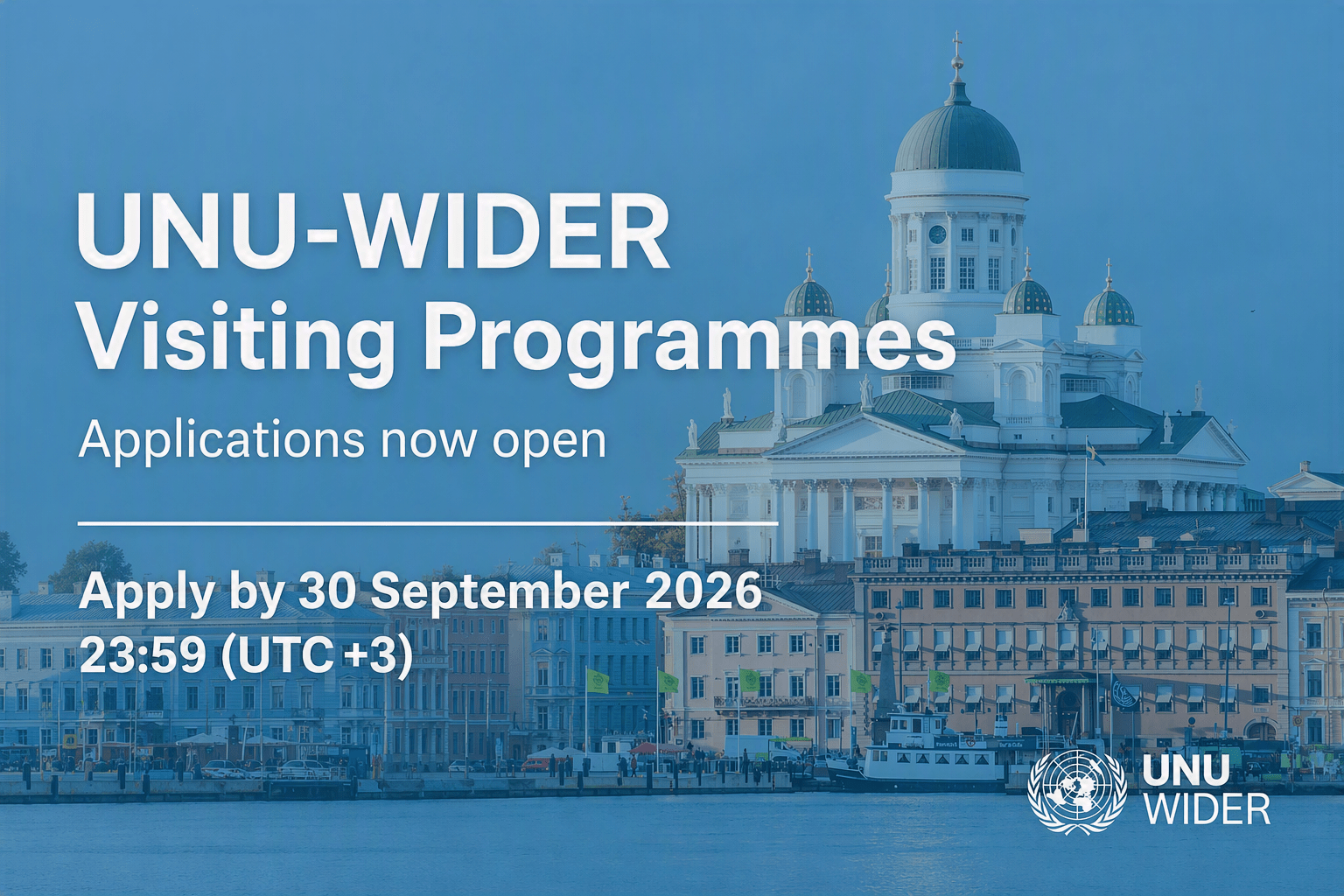
For the current application cycle, the official deadline is 30 September 2026 at 23:59 UTC+3. The programme provides a €3,375 monthly stipend as a contribution toward travel, visa, accommodation, and other out-of-pocket expenses, along with medical insurance covering sickness and accident-related medical and hospital services during the stay.
That combination makes the programme particularly interesting for experienced researchers and academics who are looking for an international research environment rather than a conventional degree scholarship.
But there is an important distinction.
This is not simply a general scholarship for anyone who wants to study in Finland. It is a research-focused visiting programme, and applicants are expected to have a PhD in economics or a development-related discipline.
So, if you have discovered the UNU-WIDER scholarship while searching for Finland Scholarships, it is worth understanding exactly what the opportunity offers, who it is designed for, and how the application works before spending time preparing your documents.
This guide explains all of that in detail.

UNU-WIDER Scholarship: What Is the Visiting Scholars Programme?
The UNU-WIDER scholarship is commonly used as a search term for the financial support attached to the UNU-WIDER Visiting Scholars Programme.
The programme itself is more accurately understood as a research residency opportunity.
UNU-WIDER gives qualified scholars the opportunity to conduct research connected with development and global economic issues while participating in the institute’s academic activities.
Rather than enrolling in a new degree programme, a selected scholar normally spends a relatively short period at UNU-WIDER working on research.
The official programme describes the stay as a two-to-three-month sabbatical. During that time, visiting scholars are expected to prepare one or more papers that may be considered for publication in the WIDER Working Paper Series and present a seminar in their field of research.
That structure is important because it changes how prospective applicants should think about the opportunity.
You are not simply applying for money to visit Finland.
You are applying for an opportunity to develop serious research in an international development economics environment.
What makes the UNU-WIDER scholarship different?
Several features distinguish the programme from ordinary student scholarships:
- It is designed for researchers rather than general undergraduate applicants.
- A PhD is normally required.
- The research should relate to development and/or global economic issues.
- The stay is short-term, generally two to three months.
- The programme is based in Helsinki, Finland.
- Scholars participate in UNU-WIDER activities.
- Scholars prepare research papers.
- Scholars present a research seminar.
- A monthly stipend of €3,375 is provided.
- Medical insurance is provided during the stay.
- Applications are submitted online.
- The application cycle is annual.
This is why calling it simply a “Finland scholarship” can be misleading.
It is better viewed as an international research opportunity with financial support.
UNU-WIDER Scholarship: Who Is Behind the Programme?
The programme is operated by the United Nations University World Institute for Development Economics Research, commonly known as UNU-WIDER.
UNU-WIDER is based in Helsinki and focuses on research related to development economics and broader global development questions.
The institute’s work covers a wide range of issues that affect developing economies and global economic development. Its research and learning activities include subjects connected with inequality, taxation, social protection, economic transformation, labour markets, development policy, and other major development challenges.
The institution’s history also helps explain why Helsinki is such an interesting location for development economics research.
UNU-WIDER’s own historical material describes Helsinki as having developed into an important hub for development economics, with researchers and intellectuals from different traditions contributing to debates around poverty, inequality, finance, trade, economic transformation, and development polic
For a visiting scholar, that environment can matter almost as much as the financial support.
Research becomes more valuable when it is connected to conversations beyond one’s home institution.
UNU-WIDER Scholarship: 7 Powerful Benefits You Should Know
The financial support is probably the first thing most applicants notice.
The €3,375 monthly stipend is certainly significant.
However, focusing only on the money misses several of the most valuable aspects of the opportunity.
Here are seven major benefits worth understanding.
UNU-WIDER Scholarship Benefit 1: €3,375 Monthly Stipend
The headline financial benefit is the €3,375 monthly stipend.
The official UNU-WIDER programme description states that the stipend is intended as a contribution toward:
- Travel expenses
- Visa expenses
- Accommodation
- Other out-of-pocket expenses
This distinction is important.
The €3,375 should not automatically be interpreted as a salary or as a guaranteed amount of disposable income.
It is a financial contribution designed to help support the scholar during the research stay.
For someone planning a two- or three-month stay, however, the support can significantly reduce the financial burden of undertaking an international research residency.
For example, a three-month stay would correspond to €10,125 in stipend payments, assuming the programme’s monthly support remains at the stated €3,375 rate throughout the three months.
That figure should be viewed as a simple calculation of the published monthly rate, not as a guarantee of a particular total payment because the exact arrangements of an individual award may depend on the programme’s terms.
The important point is that the programme offers meaningful financial support rather than requiring visiting researchers to independently finance the entire stay.
UNU-WIDER Scholarship Benefit 2: Medical Insurance During the Stay
Another benefit that can easily be overlooked is medical insurance.
UNU-WIDER states that visiting scholars receive medical insurance for medical and hospital services resulting from sickness and accident during their stay at UNU-WIDER.
For an international researcher travelling to Finland for several months, this can provide an additional layer of practical support.
It is still important for successful applicants to carefully review the precise insurance terms and understand what is and is not covered.
Applicants should not assume that every medical expense, pre-existing condition, dependent-related cost, or travel-related issue is automatically covered.
The programme specifically describes the insurance in relation to sickness and accident during the stay.
That is another reason why reading the official offer and programme conditions carefully matters.
UNU-WIDER Scholarship Benefit 3: A Research Stay in Helsinki, Finland
The location itself is another major attraction.
The programme is based in Helsinki, Finland, giving scholars the opportunity to spend several months in an international European research environment.
For an academic who normally works at a university in another country, changing research environments can be intellectually refreshing.
A short international research stay can expose a scholar to:
- Different academic networks
- New research conversations
- International colleagues
- Different approaches to development policy
- New datasets and research methods
- Seminars and academic presentations
- Potential future collaborations
Finland also has a substantial international research ecosystem.
Finnish government information highlights international research, research institutions, universities, innovation, and international talent as important components of the country’s knowledge environment. (thisisFINLAND)
This does not mean every visiting scholar will automatically establish long-term collaborations or secure future funding.
Rather, the opportunity creates an environment where those professional interactions can happen.
And sometimes that is precisely what an academic career needs: a new room, new people, and a new conversation.
UNU-WIDER Scholarship Benefit 4: Time to Develop Research
One of the most valuable benefits of the UNU-WIDER scholarship may not appear on a financial table.
It is protected research time.
Many researchers understand the problem.
You have a research idea.
You have data.
You have a paper that is half-written.
You know the literature.
But teaching, administration, meetings, supervision, institutional responsibilities, conferences, family obligations, and everyday tasks keep pushing the research backward.
A visiting research programme can create a different rhythm.
The UNU-WIDER Visiting Scholars Programme is structured around research.
The official description says scholars typically spend two to three months at the institute preparing one or more papers and presenting a seminar related to their research.
That means applicants should not approach the programme as though they are simply looking for an international experience.
The strongest application should demonstrate that the applicant has a meaningful research project that can benefit from the residency.
A good question to ask yourself is:
What could I realistically accomplish during two or three months at UNU-WIDER that would be more difficult to accomplish at home?
Your answer can help shape both your research proposal and your motivation.
UNU-WIDER Scholarship Benefit 5: Opportunity to Present Your Research
Presentation is another central feature of the programme.
Visiting scholars are expected to present a seminar in their research field.
This can be valuable because research improves when it is questioned.
A paper may look perfect when you read it alone at midnight.
Then someone asks:
“Why did you choose that identification strategy?”
Suddenly, the weakest section becomes obvious.
That is not failure.
That is research.
A seminar provides an opportunity to explain your argument, defend your methodology, receive questions, and identify areas that need clarification.
For early-career researchers especially, developing the ability to communicate complex research clearly can be just as important as producing the research itself.
The seminar requirement therefore gives the UNU-WIDER scholarship a strong academic component.
UNU-WIDER Scholarship Benefit 6: Potential Publication Pathway
The official programme states that visiting scholars prepare one or more papers to be considered for publication in the WIDER Working Paper Series.
Notice the wording: considered for publication.
This does not mean every visiting scholar is guaranteed publication.
That distinction is extremely important.
A researcher should never interpret the programme as promising an automatic publication.
Instead, the opportunity gives scholars a research environment in which they can develop work that may become suitable for consideration.
For an academic career, a stronger working paper can be useful even before publication.
It may help a researcher:
- Clarify an argument
- Strengthen methodology
- Receive expert feedback
- Build a conference presentation
- Develop a journal manuscript
- Create a foundation for future research
- Demonstrate an active research agenda
The real value therefore lies in the research process rather than simply in attaching a famous institutional name to a CV.
UNU-WIDER Scholarship Benefit 7: International Academic Networking
The seventh benefit is networking.
This word is often overused, but in research it has a very practical meaning.
It means meeting people who may later become:
- Research collaborators
- Co-authors
- Conference contacts
- Referees
- Academic mentors
- Policy research partners
- Sources of new research ideas
UNU-WIDER’s current activities demonstrate a strong emphasis on research collaboration and knowledge sharing. Its learning programme describes opportunities for research collaboration and says that its Visiting Scholars and Visiting PhD Fellowship programmes are linked closely to its research programme. (Wider Institute)
Of course, participation does not guarantee a collaboration.
The researcher still has to contribute.
That means attending seminars, asking thoughtful questions, discussing research ideas, presenting your own work clearly, and being willing to listen.
The strongest networking often happens naturally when researchers are genuinely interested in each other’s work.
UNU-WIDER Scholarship: Quick Overview of the Opportunity
| Feature | Current Programme Information |
|---|---|
| Programme | UNU-WIDER Visiting Scholars Programme |
| Location | Helsinki, Finland |
| Typical duration | 2–3 months |
| Academic level | Researchers with a PhD |
| Main disciplines | Economics or development-related disciplines |
| Research focus | Development and/or global economic issues |
| Monthly stipend | €3,375 |
| Medical insurance | Provided during the stay for specified sickness and accident-related services |
| Travel support | Stipend contributes toward travel and visa expenses |
| Accommodation | Stipend contributes toward accommodation |
| Research output | One or more papers |
| Seminar | Visiting scholars present research |
| Application method | Online application |
| Application frequency | Once each year |
| Current deadline | 30 September 2026, 23:59 UTC+3 |
| Application form availability | Opens one month before the deadline |
| Dependents | Dependent-related services and expenses are not covered |
The figures and conditions above are based on the current official UNU-WIDER programme information.
UNU-WIDER Scholarship: Eligibility Requirements Explained
The UNU-WIDER Visiting Scholars eligibility and application requirements should be one of the first sections you study before preparing an application.
The official criteria state that applicants should have a PhD degree in economics or a development-related discipline.
A good publication record is described as an added advantage.
The programme also says applications from suitably qualified early-career, female, and developing-country researchers are particularly encouraged.
This does not mean that every person in one of those groups will be selected.
It means those categories are specifically encouraged within the programme’s stated selection approach.
Academic qualification
The clearest requirement is the PhD.
If your academic background is in economics, that is directly aligned with the stated requirement.
If your degree is in another discipline, the important question becomes whether it is sufficiently related to development.
Development research is naturally interdisciplinary.
Relevant areas may include fields connected with:
- Development economics
- Public economics
- International economics
- Labour economics
- Agricultural economics
- Political economy
- Economic policy
- Social policy
- Development studies
- Related development-oriented disciplines
However, applicants should assess their own academic background against the official wording rather than assuming that every social science or humanities discipline automatically qualifies.
Research record
A good publication record is an advantage.
That does not mean you should count yourself out if you are an early-career researcher.
The official programme specifically says suitably qualified early-career researchers are encouraged to apply. (Wider Institute)
The more useful question is:
Does my existing research demonstrate that I can successfully undertake the project I am proposing?
That could be demonstrated through:
- Published journal articles
- Working papers
- Conference papers
- A doctoral thesis
- Research reports
- Policy research
- Research assistant experience
- Relevant datasets or empirical work
The quality and relevance of your research story matter.
UNU-WIDER Scholarship: What Kind of Research Is Relevant?
The programme is designed around development and/or global economic issues.
This gives applicants considerable room to propose meaningful research.
UNU-WIDER’s research environment covers major development questions, and the institute continues to work on areas involving economic transformation, inequality, fiscal policy, labour markets, social protection, taxation, and other development-related challenges. Its current activities also include research involving secure data labs, tax gap analysis, public finance, jobs, labour markets, and inclusive development.
Potential research directions could include questions such as:
Poverty and inequality
Research might explore:
- Income inequality
- Wealth distribution
- Poverty reduction
- Intergenerational mobility
- Social protection
- Distributional effects of public policy
Labour markets
Possible areas include:
- Informal employment
- Youth employment
- Labour productivity
- Gender gaps
- Jobs and structural transformation
- Employment transitions
Public finance
Research could examine:
- Taxation
- Tax compliance
- Public expenditure
- Fiscal policy
- Tax-benefit systems
- Government revenue
Economic transformation
Possible topics include:
- Industrial policy
- Structural transformation
- Productivity
- Trade
- Manufacturing
- Economic diversification
- Global value chains
Development and technology
Modern development research can also explore:
- Digitalisation
- Artificial intelligence
- Technology adoption
- Digital financial services
- Productivity
- Innovation
The important point is not to choose a trendy topic simply because it sounds impressive.
Your proposed research should be something you understand deeply enough to execute.
UNU-WIDER Scholarship: How to Make Your Research Proposal Stronger
One of the biggest mistakes applicants can make is treating the research proposal as a formality.
It is not.
Your proposal gives the selection committee an opportunity to understand what you want to investigate and why UNU-WIDER is an appropriate environment for that work.
A strong proposal should answer several basic questions.
1. What is the research problem?
Do not begin with an enormous global statement.
Start with a precise problem.
For example:
Instead of:
Poverty remains one of the biggest problems in Africa.
Consider something more specific:
This study examines whether changes in social protection coverage affect labour-market transitions among low-income households in selected African economies.
The second statement gives the reader something concrete to evaluate.
2. Why does the question matter?
Explain the economic or policy significance.
What could decision-makers learn from the research?
Who would benefit from the evidence?
What existing debate does your research contribute to?
3. What does the existing literature say?
Show that you understand the research landscape.
You do not need to summarize every paper ever written.
Instead:
- Identify the major debate.
- Explain what researchers already know.
- Identify a gap.
- Explain how your project addresses the gap.
4. What data will you use?
Be specific.
If you already have access to a dataset, say so.
If you intend to use administrative data, survey data, panel data, or international databases, explain the source.
5. What method will you use?
Explain the methodology clearly.
You do not need to fill the proposal with unnecessary technical terminology.
The committee needs to understand why your method is appropriate for answering your question.
6. What will you accomplish during the visit?
This is especially important for a short-term programme.
You have only two to three months.
Your plan therefore needs to be realistic.
For example:
Month 1
- Literature refinement
- Data preparation
- Initial analysis
Month 2
- Main empirical analysis
- Drafting
- Seminar presentation
Month 3
- Revision
- Additional analysis
- Final paper development
Your actual schedule should depend on your research project, but the principle is simple:
Show that you have a realistic plan for the time available.
UNU-WIDER Scholarship: Application Process Explained
The UNU-WIDER Visiting Scholars eligibility and application process is conducted online.
The official programme states that applications are accepted once each year and that the current deadline is 30 September at 23:59 UTC+3.
An important detail is that the online application form becomes active only one month before the submission deadline, which means it becomes available on 1 September each year.
This is useful information for applicants who search for the application page months in advance and assume the programme is closed.
Basic application sequence
A practical application workflow looks like this:
- Review the official programme requirements.
- Confirm that your academic background aligns with the eligibility criteria.
- Develop a clear research project.
- Review your CV.
- Gather supporting information.
- Prepare the application carefully.
- Upload the required CV.
- Submit the application through the official online system.
- Save confirmation of submission.
- Monitor your email after the deadline.
The official programme specifically says that applications are not accepted by email or post. (Wider Institute)
That means sending your CV by email instead of using the application system is not a substitute for submitting the online application.

UNU-WIDER Scholarship: What Documents Should You Prepare?
Applicants should always rely on the current application form for the exact information requested.
However, it is sensible to prepare the following materials early:
Updated academic CV
Your CV should clearly show:
- Education
- PhD
- Research positions
- Publications
- Working papers
- Research interests
- Conference participation
- Relevant professional experience
- Awards or fellowships
- Research methods
- Selected projects
Do not make your CV unnecessarily long.
A research-focused CV should make it easy for an academic reviewer to understand what you research and what you have already accomplished.
Research proposal
Your proposal should be focused, realistic, and connected to development or global economic questions.
Publication information
If you have published research, organize the information clearly.
If you have working papers, distinguish them from peer-reviewed publications.
Academic background
Be prepared to demonstrate the relevance of your PhD and broader research experience.
Research plan
Think carefully about what you intend to accomplish during the two-to-three-month residency.
UNU-WIDER Scholarship: How the Selection Process Works
Many applicants focus only on the deadline.
The selection process deserves equal attention.
The official programme says applicants are expected to have a PhD in economics or a development-related discipline and that a good publication record is an advantage. It also states that preference is given to applicants whose research overlaps with UNU-WIDER’s current research programme, while remaining open to proposals covering all aspects of development.
This suggests several practical lessons.
Relevance matters
Your research does not need to copy an existing UNU-WIDER project.
However, you should demonstrate why the research belongs in a development research environment.
Feasibility matters
A brilliant research question is not enough if it cannot be completed within the proposed period.
Evidence matters
Your academic background should give reviewers confidence that you can conduct the project.
Clarity matters
A proposal that is easy to understand can be more effective than one overloaded with technical terminology.
UNU-WIDER Scholarship: What Happens After You Apply?
Applicants should understand the expected timeline.
The official programme states that selected applicants are informed by email of the final decision approximately within two months after the closing deadline. Selected applicants must then confirm whether they will take up the offer within two weeks after being contacted.
This means applicants should monitor the email address used during the application process.
It also means you should avoid making non-refundable travel arrangements based solely on the assumption that you will be selected.
Wait for official confirmation and follow the instructions provided to successful applicants.
UNU-WIDER Scholarship: Is It Fully Funded?
This is one of the most important questions surrounding the programme.
You will often see opportunities like this described online as “fully funded.”
However, applicants should read that phrase carefully.
The official UNU-WIDER description says the programme provides:
- A €3,375 monthly stipend
- Medical insurance
- A stipend contribution toward travel
- A stipend contribution toward visa expenses
- A stipend contribution toward accommodation
- A possible supplementary travel grant in certain circumstances
The programme also explicitly says that it does not provide services or cover expenses related to dependents.
Therefore, rather than assuming that every possible expense is automatically paid, applicants should think of the programme as offering substantial financial support with specified coverage.
That is a more accurate way to understand the opportunity.
UNU-WIDER Scholarship: Can You Get Additional Travel Support?
Yes, under specific conditions.
The official programme says visiting scholars may apply for a supplementary grant to cover high travel costs, including visa and related travel, for the portion exceeding €1,200, based on the lowest economy-class fare.
However, the scholar must pay for the ticket, and the programme states that the applicant must not receive another travel grant from another source for the same expense.
This is an important detail for international applicants.
It means you should keep documentation related to travel costs and carefully review the conditions before assuming you qualify for additional support.
UNU-WIDER Scholarship: What About Family Members and Dependents?
Applicants travelling with family should pay particular attention to this issue.
The official programme states that it does not provide services or cover expenses related to dependents. (Wider Institute)
Therefore, if you plan to travel with:
- A spouse
- Children
- Other dependents
you should prepare a separate financial plan for their travel, accommodation, insurance, and living expenses.
The €3,375 stipend should not be treated as a family package.
This is particularly important when building a realistic budget.
UNU-WIDER Scholarship: Understanding the Difference Between the Scholarship and Fellowship
The terms UNU-WIDER scholarship and UNU-WIDER Fellowship are sometimes mixed together online.
That can create confusion.
UNU-WIDER has both a Visiting Scholars Programme and a separate Visiting PhD Fellowship Programme.
The Visiting Scholars Programme is aimed at qualified scholars who already hold a PhD.
The Visiting PhD Fellowship, as the name suggests, is designed for doctoral researchers.
UNU-WIDER itself lists both programmes as separate opportunities.
Therefore, if you are searching for the UNU-WIDER Fellowship, make sure you are looking at the correct programme.
Simple distinction
| Programme | Intended participant |
|---|---|
| UNU-WIDER Visiting Scholars Programme | Qualified scholars, normally with a PhD |
| UNU-WIDER Visiting PhD Fellowship | Doctoral/PhD researchers |
This distinction can save applicants a lot of confusion.
If you have already completed your PhD, the Visiting Scholars Programme is the relevant opportunity to investigate.
If you are still completing your doctorate, the Visiting PhD Fellowship may be more appropriate, subject to its own eligibility rules and current availability.
UNU-WIDER Scholarship: Why the €3,375 Figure Matters
The phrase “UNU-WIDER scholarship €3,375 monthly stipend” is likely to attract considerable search attention because it immediately answers one of the biggest questions applicants have:
How much financial support does the programme provide?
At €3,375 per month, the published rate represents substantial assistance for a short research residency.
For illustration:
- 1 month = €3,375
- 2 months = €6,750
- 3 months = €10,125
These are straightforward calculations using the published monthly rate.
However, the programme describes the stipend as a contribution toward expenses rather than a salary.
That distinction matters.
A researcher should budget for:
- Accommodation
- Food
- Local transportation
- International travel
- Visa-related expenses
- Research-related costs
- Personal expenses
- Any costs for dependents
The actual cost of living will vary according to lifestyle, accommodation arrangements, and other personal circumstances.
UNU-WIDER Scholarship: Why Finland Is an Interesting Research Destination
Finland is not simply the backdrop for this opportunity.
The country’s research ecosystem is part of the attraction.
Finnish government information describes Finland as having a strong research and innovation environment, while official material about international research highlights the role of universities, research institutions, funding bodies, and international researchers. (thisisFINLAND)
For international scholars, the broader research environment can offer exposure to different institutional practices and international academic networks.
Helsinki, in particular, provides access to an international policy and research environment.
That does not mean every visiting researcher will have the same experience.
But the setting creates opportunities for intellectual exchange.
UNU-WIDER Scholarship: Preparing for Life in Finland
Winning the programme is only one part of the process.
International researchers also need to prepare for their stay.
Depending on nationality and immigration status, you may need the appropriate visa or residence documentation.
Applicants should not assume that the scholarship itself automatically provides immigration authorization.
Visa and residence requirements depend on the individual’s circumstances.
Before travelling, successful applicants should check the latest official Finnish immigration instructions applicable to their nationality and purpose of stay.
This is especially important because immigration rules and application procedures can change.
The Finnish government directs people seeking information about visas and residence permits to the Finnish Immigration Service and relevant official authorities. (thisisFINLAND)
UNU-WIDER Scholarship: How to Prepare Before the Application Opens
Because the application form becomes available only one month before the deadline, waiting until September to begin preparing can put you under unnecessary pressure.
A smarter strategy is to prepare months in advance.
Three to six months before the deadline
Start by:
- Identifying your research question.
- Reviewing relevant literature.
- Updating your CV.
- Identifying suitable datasets.
- Clarifying your methodology.
- Reviewing UNU-WIDER’s research areas.
- Thinking about how your work connects to development economics.
One to two months before the deadline
Focus on:
- Refining your proposal.
- Editing your CV.
- Checking academic records.
- Reviewing your research plan.
- Preparing answers for application questions.
- Getting feedback from a trusted academic colleague.
When the application opens
The official application form becomes available on 1 September, one month before the September 30 deadline. (Wider Institute)
At that point:
- Read every question carefully.
- Avoid rushing.
- Check every uploaded document.
- Ensure your CV is current.
- Proofread your research proposal.
- Submit before the final hours.
UNU-WIDER Scholarship: 10 Mistakes Applicants Should Avoid
Even strong researchers can weaken an application through simple mistakes.
1. Treating the programme like a general student scholarship
The programme is research-focused.
Your application should therefore communicate your research identity.
2. Writing a vague research proposal
Avoid broad statements that could apply to hundreds of projects.
Be specific.
3. Ignoring UNU-WIDER’s research environment
Your project should make sense within development and global economic research.
4. Making unrealistic promises
Two or three months is not enough time to solve every dimension of a global development problem.
Keep the project achievable.
5. Overloading the proposal with jargon
Complex research does not need complicated writing.
Explain your research so that an informed academic reader can quickly understand the central idea.
6. Forgetting the seminar requirement
Remember that the programme includes a research presentation.
You should be prepared to explain your work clearly.
7. Assuming publication is guaranteed
The programme says papers may be considered for publication.
It does not promise publication to every participant.
8. Ignoring dependent costs
Dependent expenses are not covered by the programme.
9. Waiting until the final day
Technical problems, document issues, or internet problems can happen.
Submit early.
10. Using unofficial information as the final authority
Scholarship websites can be useful for discovering opportunities.
But when dates, funding, eligibility, or application rules matter, verify them against the official UNU-WIDER announcement.
UNU-WIDER Scholarship: A Practical Application Checklist
Before submitting, ask yourself:
Eligibility
- Do I have a PhD?
- Is my PhD in economics or a development-related discipline?
- Does my research fit development and/or global economic issues?
- Can I demonstrate relevant research experience?
Research
- Is my research question specific?
- Is the project realistic for two to three months?
- Do I understand the existing literature?
- Is my methodology appropriate?
- Can I explain the policy or development relevance?
Documents
- Is my CV updated?
- Have I clearly listed publications?
- Have I distinguished publications from working papers?
- Have I checked every application field?
- Are my uploaded files readable?
Planning
- Have I considered travel costs?
- Have I considered accommodation?
- Have I checked visa requirements?
- Have I considered insurance details?
- Have I planned for any dependent-related expenses?
Submission
- Did I use the official online application system?
- Did I submit before the deadline?
- Did I save confirmation of submission?
- Will I monitor my email after submission?
UNU-WIDER Scholarship: What Makes a Research Proposal Stand Out?
There is no guaranteed formula for selection.
However, applicants can improve the clarity and credibility of their proposal by presenting a coherent research story.
Think of the proposal as a chain:
Problem → Evidence → Research Gap → Question → Method → Expected Contribution
If one link is weak, the entire argument becomes harder to follow.
For example:
Problem
A country has experienced rapid economic growth, but income inequality remains high.
Existing evidence
Previous research has examined national income distribution but has paid less attention to regional differences.
Research gap
There is limited evidence about how structural transformation affects regional inequality.
Research question
How does structural transformation influence regional income inequality?
Method
Use regional panel data to estimate the relationship between structural transformation and income distribution.
Contribution
The study could provide evidence relevant to regional development policy.
This is much stronger than simply saying:
“I want to study inequality in developing countries.”
The second statement may be important, but it is not yet a research project.
UNU-WIDER Scholarship: How Early-Career Researchers Can Compete
The programme explicitly encourages suitably qualified early-career researchers.
That is encouraging for researchers who may not have decades of publication history.
If you are early in your career, emphasize the evidence you do have.
For example:
- Your PhD research
- Dissertation chapters
- Working papers
- Conference presentations
- Research assistantships
- Empirical projects
- Policy reports
- Data analysis experience
- Research collaborations
- Relevant publications
Do not apologize for being early-career.
Instead, show where your research is going.
A convincing application can demonstrate that the proposed visit is the logical next step in an already developing research agenda.
UNU-WIDER Scholarship: Advice for Researchers From Developing Countries
The programme specifically encourages applications from suitably qualified researchers from developing countries. (Wider Institute)
For these applicants, it can be useful to clearly explain the relevance of the research to development challenges.
For example, if your research focuses on:
- African labour markets
- Poverty
- Agricultural productivity
- Taxation
- Public finance
- Informal employment
- Social protection
- Inequality
- Gender and economic opportunity
- Structural transformation
explain what your research adds to the evidence base.
Do not assume the reviewer automatically understands the importance of your local context.
Explain it.
A researcher working on Nigeria, Ghana, Kenya, Ethiopia, South Africa, Bangladesh, India, or another developing economy can make the proposal stronger by connecting the specific country case to a broader development question.
That way, the research is not simply:
“I am studying my country.”
It becomes:
“My country provides evidence that helps us understand a broader development problem.”
That distinction can transform the framing of a proposal.
UNU-WIDER Scholarship: Can the Programme Help Your Academic Career?
A short research residency cannot guarantee a promotion, publication, academic appointment, or future funding.
However, it can contribute to a researcher’s professional development.
A successful participant may leave the programme with:
- A more developed research paper
- Seminar presentation experience
- New academic contacts
- International research exposure
- Greater familiarity with development economics networks
- Potential collaboration opportunities
- A stronger research portfolio
The value depends heavily on what the researcher does with the opportunity.
A person who arrives in Helsinki, attends the minimum number of activities, and leaves with an unfinished paper may gain less than someone who actively participates, asks questions, receives feedback, revises their work, and builds professional relationships.
The opportunity provides the environment.
The researcher still has to use it..
UNU-WIDER Scholarship: Frequently Asked Questions
What is the UNU-WIDER scholarship?
The term UNU-WIDER scholarship is commonly used to describe the financial support associated with the UNU-WIDER Visiting Scholars Programme. The programme allows qualified researchers to spend approximately two to three months at UNU-WIDER in Helsinki conducting development-related research.
How much is the UNU-WIDER scholarship?
The programme currently provides a €3,375 monthly stipend. UNU-WIDER says the stipend contributes toward travel, visa, accommodation, and other out-of-pocket expenses.
Is the UNU-WIDER scholarship fully funded?
The programme provides substantial financial support and medical insurance, but applicants should not interpret “fully funded” as meaning that every possible expense for the scholar or dependents is automatically covered. The official programme specifically states that dependent-related expenses are not covered.
Who can apply for the UNU-WIDER scholarship?
Applicants should have a PhD in economics or a development-related discipline. A strong publication record is an advantage. The programme particularly encourages suitably qualified early-career, female, and developing-country researchers.
Where is the UNU-WIDER scholarship located?
The programme takes place at UNU-WIDER in Helsinki, Finland.
How long is the UNU-WIDER Visiting Scholars Programme?
Scholars typically spend two to three months at UNU-WIDER.
What research areas are accepted?
The programme focuses on research related to development and/or global economic issues. UNU-WIDER says it prefers applicants whose research overlaps with its current research programme but remains open to proposals covering all aspects of development.
Is there a publication opportunity?
Visiting scholars prepare one or more papers that may be considered for publication in the WIDER Working Paper Series. Publication is not guaranteed.
Do visiting scholars have to present their research?
Yes. The programme states that scholars present a seminar in their field of research.
When is the current application deadline?
The official current deadline is 30 September 2026 at 23:59 UTC+3.
When does the application form open?
The online application form becomes active one month before the deadline, on 1 September each year.
Can I apply by email?
No. UNU-WIDER states that it accepts online applications and does not receive applications by email or post
Does the programme cover dependents?
No. UNU-WIDER states that the programme does not provide services or cover expenses related to dependents.
Is the UNU-WIDER Fellowship the same as the Visiting Scholars Programme?
No. UNU-WIDER lists the Visiting Scholars Programme separately from its Visiting PhD Fellowship Programme. The Visiting Scholars Programme is intended for qualified scholars, while the Visiting PhD Fellowship is for doctoral researchers. (Wider Institute)
Final Thoughts for Prospective Applicants
The UNU-WIDER scholarship opportunity is interesting because it brings together several things that are difficult to find in one short-term research programme: an international research environment, a respected development economics institution, a two-to-three-month research residency, a €3,375 monthly stipend, medical insurance, opportunities to present research, and the possibility of developing work for consideration in the WIDER Working Paper Series. (Wider Institute)
But the most important point is this:
It is a research opportunity first and a financial opportunity second.
The money matters.
The chance to spend time in Finland matters.
The international experience matters.
But your research remains at the centre of the programme.
If you are considering applying, do not begin by asking only:
“How much does the UNU-WIDER scholarship pay?”
Ask a more useful question:
“What important research can I advance if I have two or three months in this environment?”
That question can change the way you approach the entire application.
Build your proposal around a precise research problem. Demonstrate that you understand the literature. Explain your methodology without unnecessary complexity. Show why the research matters. Connect your project naturally to development and global economic questions. Make your CV tell a coherent story about the researcher you are becoming.
And above all, verify the final requirements against the official UNU-WIDER announcement before submitting.
For the current cycle, the official deadline is 30 September 2026 at 23:59 UTC+3, and the programme says the online application form becomes active on 1 September. (Wider Institute)
For applicants who meet the academic requirements and have a serious development-related research project, the opportunity represents much more than a trip to Finland.
It can be a focused period to think deeply, test ideas, improve a paper, receive academic feedback, participate in an international research environment, and return home with research that is stronger than when you arrived.
That is ultimately what makes the UNU-WIDER Visiting Scholars Programme worth serious consideration.
Shortcut👇.