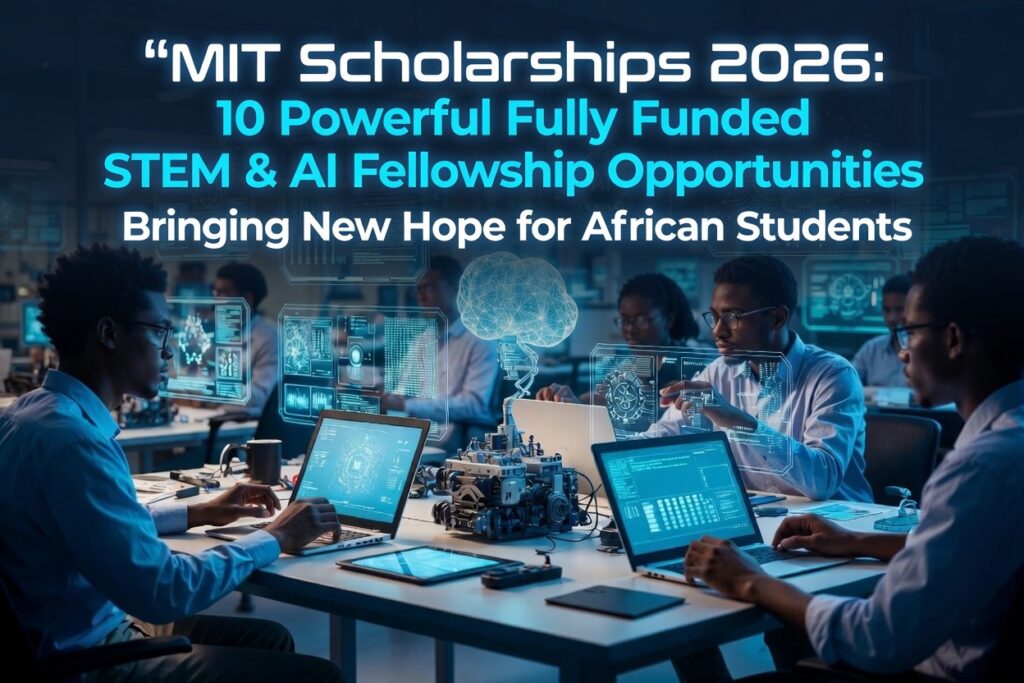
MIT Scholarships 2026
For thousands of ambitious African students, studying at the Massachusetts Institute of Technology has always felt like a distant dream — inspiring, prestigious, but financially impossible. Yet 2026 is beginning to change that narrative in powerful ways.
Across Africa, a new generation of innovators is emerging. Young engineers in Nigeria are building AI-powered agricultural systems. Kenyan software developers are creating fintech tools that rival global platforms. Ghanaian researchers are contributing to renewable energy projects that address climate change. The hunger for world-class education has never been stronger.
At the same time, the global demand for STEM professionals, AI researchers, data scientists, robotics engineers, and technology innovators is rising rapidly. Universities like MIT are actively expanding research funding and graduate fellowship opportunities to attract exceptional international talent.
This is why MIT Scholarships 2026 are becoming one of the most searched educational opportunities among African students.
What makes these opportunities especially exciting is that many are not traditional scholarships alone. They combine:
- Full tuition coverage
- Research assistantships
- Monthly stipends
- AI innovation grants
- International research fellowships
- Technology incubation funding
- Travel support
- Healthcare benefits
For many students, these programs are life-changing.
Even more importantly, several funding pathways remain open or underutilized because many applicants simply do not know they exist.
This article explores the most powerful Fully Funded STEM Scholarships and fellowship opportunities connected to MIT in 2026, especially for African students seeking graduate and PhD education in science, engineering, artificial intelligence, and emerging technologies.
We will also examine:
- How MIT funding actually works
- The difference between fellowships and assistantships
- AI-focused opportunities gaining popularity in 2026
- Practical application strategies
- Common mistakes African applicants make
- How global economic changes are influencing scholarship funding
If you have ever imagined yourself studying at one of the world’s top universities, this guide may completely reshape how you see your chances.

Why MIT Scholarships 2026 Are Becoming More Competitive for African Students
The competition for MIT funding is intensifying for several reasons.
First, the world economy is becoming increasingly technology-driven. Governments, private organizations, and research institutions are investing heavily in AI, robotics, cybersecurity, renewable energy, biotechnology, and advanced computing.
Second, recent global economic instability has pushed more students toward fully funded education opportunities abroad. Rising tuition costs, inflation pressures, and currency fluctuations across developing nations have made international scholarships more essential than ever.
Interestingly, geopolitical developments are also influencing educational funding trends.
The growing discussion around the Impact of Iran conflict on global inflation and recession risks in 2026 economy forecast has raised concerns about economic uncertainty, oil prices, research funding priorities, and global talent migration. As economies respond to instability, STEM innovation and AI research are increasingly viewed as strategic priorities worldwide.
This means universities like MIT are directing more resources toward scientific research and high-impact technological development.
For African students, this creates both opportunity and competition.
The good news?
MIT is actively interested in global perspectives and diverse talent pools.
Understanding How MIT Scholarships 2026 Actually Work
One of the biggest misconceptions about MIT is that students apply for “one giant scholarship.”
That is not how the system works.
Instead, MIT funding usually comes through multiple channels:
Main MIT Funding Sources
1. Research Assistantships (RA)
Students work on funded research projects while receiving:
- Tuition coverage
- Monthly stipend
- Research experience
- Faculty mentorship
This is extremely common for STEM and AI graduate programs.
2. Teaching Assistantships (TA)
Graduate students assist professors with:
- Tutorials
- Laboratory sessions
- Grading
- Undergraduate mentoring
In return, students receive financial support.
3. Fellowships
Fellowships are highly prestigious because they often provide funding without requiring work obligations.
They may come from:
- MIT departments
- External foundations
- Technology companies
- Government agencies
- Research institutions
4. External Research Grants
Many professors secure funding from organizations like:
- National science agencies
- Technology firms
- Innovation labs
- AI research foundations
Students attached to these labs benefit directly.
10 Powerful MIT Scholarships 2026 and AI Fellowship Opportunities
Below are some of the strongest opportunities African students should explore.
1. MIT Presidential Fellowship Program
The Presidential Fellowship is among the most prestigious graduate funding opportunities available at MIT.
It is designed for exceptional incoming PhD students with outstanding academic potential and leadership capacity.
What It Covers
- Full tuition
- Living stipend
- Health insurance
- Research support
Best Fields
- Artificial Intelligence
- Electrical Engineering
- Computer Science
- Biotechnology
- Mechanical Engineering
- Data Science
Why African Students Should Pay Attention
MIT increasingly values global innovation perspectives, especially applicants working on real-world development challenges.
Students with projects addressing:
- Healthcare systems
- Agricultural technology
- Renewable energy
- Financial inclusion
- AI for social impact
often stand out strongly.
for more insights on the fellowship,visit:
2. MIT Graduate Research Fellowships for African PhD Students in AI
Artificial Intelligence remains one of the fastest-growing academic investment areas globally.
The demand for AI experts is expanding across:
- Healthcare
- Climate science
- Security
- Transportation
- Education technology
- Financial systems
As a result, MIT graduate research fellowships for African PhD students in AI are becoming significantly more valuable.
for more informations on the admission ,visit:
Areas Receiving Strong Funding
- Machine Learning
- Robotics
- Natural Language Processing
- AI Ethics
- Computer Vision
- Quantum Computing
Competitive Advantage for African Applicants
African students working on locally relevant AI problems can gain major attention.
Examples include:
- AI-powered crop monitoring
- Language processing for African languages
- Smart healthcare diagnostics
- Mobile fintech security systems
MIT values research with measurable societal impact.
3. Legatum Fellowship at MIT
The Legatum Fellowship focuses on entrepreneurship and innovation in developing economies.
It supports students committed to transformative change.
Benefits
- Tuition support
- Living expenses
- Entrepreneurial mentorship
- Startup ecosystem access
Strong Candidates Usually Have
- Leadership history
- Startup ideas
- Social innovation projects
- Technology-driven development goals
This fellowship aligns particularly well with African students building scalable solutions for economic development.
4. MIT PhD Grants in Engineering and Technology
Many students searching for MIT PhD Grants mistakenly assume funding is limited to academic excellence alone.
In reality, research alignment matters just as much.
What MIT Looks For
- Strong academic records
- Research publications
- Technical projects
- Programming skills
- Research potential
- Faculty compatibility
Engineering Fields with Strong Funding
| Field | Funding Strength | Demand Trend |
|---|---|---|
| Artificial Intelligence | Very High | Explosive Growth |
| Renewable Energy | High | Rising |
| Robotics | Very High | Rapid Expansion |
| Biomedical Engineering | High | Strong |
| Aerospace Engineering | Moderate-High | Stable |
| Cybersecurity | Very High | Expanding |
| Quantum Computing | Extremely High | Emerging |
This table highlights where funding concentration is strongest heading into 2026 and beyond.
5. Fully Funded STEM Scholarships Through MIT Research Labs
MIT research laboratories are among the most influential innovation hubs globally.
Many graduate students receive funding directly through laboratory projects.
Major MIT Labs Supporting International Researchers
- Computer Science and Artificial Intelligence Laboratory (CSAIL)
- Media Lab
- Lincoln Laboratory
- Energy Initiative
- Microsystems Technology Laboratories
These labs often collaborate with:
- Governments
- Global corporations
- AI startups
- Defense research agencies
- Healthcare institutions
For African students, joining a lab can unlock not only education but long-term international career opportunities.
6. MIT-Africa Research Collaboration Opportunities
MIT has increasingly expanded partnerships focused on Africa-centered innovation.
Areas attracting growing interest include:
- Sustainable agriculture
- Climate resilience
- Public health systems
- Renewable energy
- Smart infrastructure
- Digital economies
Students involved in regional innovation projects often gain stronger research positioning during admissions.
7. Knight-Hennessy and Cross-Institution Opportunities
Although based at Stanford University, some students combine external fellowships with MIT collaborations and research partnerships.
This strategy is increasingly common among high-performing international students.
Many African applicants overlook cross-institution research ecosystems.
8. AI and Robotics Innovation Scholarships
The AI revolution is reshaping higher education funding globally.
Companies are aggressively funding:
- AI safety research
- Autonomous systems
- Robotics engineering
- Neural networks
- Human-computer interaction
This trend strongly benefits students pursuing:
- Machine learning
- Robotics
- Computational neuroscience
- AI ethics
The rise of AI funding explains why Fully funded AI and technology scholarships in the USA for African students 2026 are trending heavily in search engines.
9. Climate Technology and Sustainability Fellowships
As climate concerns intensify globally, sustainability-focused STEM research is receiving massive investments.
MIT is actively supporting research related to:
- Clean energy
- Smart cities
- Water systems
- Climate adaptation
- Carbon reduction technologies
African students researching energy access and sustainable development have particularly strong opportunities here.
10. External Technology Company Sponsored Fellowships
Major companies now sponsor graduate research at elite universities.
Examples include partnerships connected to:
- Microsoft
- NVIDIA
- IBM
- OpenAI-related ecosystems
These sponsorships often support:
- AI research
- Data science
- Semiconductor engineering
- Advanced computing
The competition is intense, but the rewards are extraordinary.

How to Apply for MIT PhD Scholarships for International Students 2026
Many talented students lose opportunities because they misunderstand the admissions process.
Understanding How to apply for MIT PhD scholarships for international students 2026 is essential.
Step 1: Build a Strong Academic Foundation
MIT prioritizes:
- Excellent GPA
- Technical depth
- Research ability
- Independent thinking
Step 2: Develop Research Experience
Research experience matters enormously.
Strong applicants often have:
- Publications
- Final-year projects
- Conference participation
- Research internships
- Open-source contributions
Step 3: Identify Potential Supervisors
This is one of the most important steps.
You should:
- Read faculty publications
- Understand lab projects
- Align your interests carefully
- Mention specific research overlap
Generic applications rarely succeed.
Step 4: Write a Powerful Statement of Purpose
Your SOP should explain:
- Your academic journey
- Your research interests
- Why MIT specifically fits your goals
- Your long-term impact vision
Avoid clichés.
Focus on authenticity and measurable experiences.
Step 5: Secure Strong Recommendations
MIT values recommendation letters from people who truly understand your academic ability.
Strong referees include:
- Research supervisors
- Professors
- Technical mentors
- Industry researchers
Common Mistakes African Students Make When Applying for MIT Scholarships 2026
Applying Without Research Alignment
Many students apply broadly without understanding faculty interests.
This weakens applications significantly.
Ignoring Research Publications
Even small publications can improve credibility.
Weak SOP Narratives
A statement filled with generic motivational language rarely works.
MIT values evidence, curiosity, and intellectual depth.
Late Applications
Many fellowships have earlier deadlines than admissions themselves.
Preparation should begin months in advance.
Why STEM and AI Scholarships Are Expected to Grow Until 2027
Several global forces are fueling continued growth in scholarship funding.
1. Global AI Competition
Countries are competing aggressively for AI leadership.
This increases investment in talent development.
2. Technology Workforce Shortages
There is a growing shortage of highly trained STEM researchers worldwide.
3. Climate Innovation Demands
Sustainability research requires advanced scientific talent.
4. Economic Uncertainty
Ironically, economic instability often increases investment in innovation sectors.
The ongoing discussion surrounding the Impact of Iran conflict on global inflation and recession risks in 2026 economy forecast reflects broader concerns about energy systems, technological independence, and economic resilience.
Governments increasingly see STEM advancement as strategic protection against future instability.
Best Strategies to Increase Your Chances of Winning MIT Scholarships 2026
Focus on Real-World Problems
MIT values practical innovation.
Projects solving African challenges can become major strengths.
Build Technical Portfolios
Strong portfolios may include:
- GitHub projects
- AI prototypes
- Research papers
- Technical blogs
- Innovation competitions
Gain International Visibility
Participate in:
- Online conferences
- Research collaborations
- Open-source communities
- Innovation programs
Start Early
Competitive applications are rarely rushed.
Successful applicants often prepare 12–18 months ahead.
The Emotional Reality Behind Fully Funded STEM Scholarships
For many African students, scholarship opportunities represent far more than financial aid.
They symbolize:
- Possibility
- Mobility
- Recognition
- Global inclusion
- Intellectual freedom
Behind every successful scholarship story is usually a long journey filled with uncertainty, resilience, rejection, and persistence.
Many MIT-funded students once believed elite education was inaccessible to people from ordinary backgrounds.
Yet year after year, determined applicants continue proving otherwise.
MIT Scholarships 2026 Deadlines and Application Timeline for African Students
Understanding the timeline and deadlines for MIT funding is one of the most important steps in successfully securing admission and financial support. Many African students miss out on MIT Scholarships 2026 not because they are unqualified, but because they fail to properly understand how MIT’s decentralized funding system works.
Unlike many universities with a single scholarship deadline, MIT operates on a department-based funding structure, meaning deadlines vary depending on your chosen program, faculty, and research area.
MIT Scholarships 2026 Deadlines and Application Timeline for African Students
1. No Single Global Scholarship Deadline at MIT
One of the most important realities to understand is that MIT does NOT have one universal scholarship deadline.
Instead:
- Each department sets its own deadline
- Funding is tied to graduate admission applications
- Fellowships and assistantships are awarded after admission
According to MIT’s Office of Graduate Education, application timelines vary significantly by department, but generally follow a seasonal pattern. MIT Graduate Admissions Timeline
2. General MIT Graduate Application Timeline (2026 Estimate)
While exact dates differ, most departments follow a structure similar to this:
Early Preparation Phase (March – August 2025)
This is when serious applicants begin preparing:
- Selecting research fields (AI, robotics, engineering, etc.)
- Preparing academic transcripts
- Building research experience
- Contacting potential supervisors
- Writing first drafts of SOPs
Tip for African students: This is the phase where you build your competitive edge, not just apply.
Application Window Opens (September – November 2025)
- Online applications become available
- Recommendation letters are requested
- Standardized tests (if required) are completed
- CV and research portfolio finalized
Department Deadlines (December 2025 – January 2026)
This is the most critical stage.
- Most MIT graduate programs close applications around December–January
- Some engineering and AI programs close earlier due to high demand
- Late applications are rarely considered
Review and Interview Stage (January – March 2026)
- Applications are reviewed by faculty committees
- Shortlisted candidates may be interviewed
- Research fit is heavily evaluated
Funding Decisions (March – April 2026)
- Admission offers are released
- Funding packages (RA, TA, fellowships) are included
- Applicants must respond before April 15 (CGS rule)
MIT Scholarships 2026 Application Timeline Summary Table
| Stage | Period | Key Activity | Importance |
|---|---|---|---|
| Preparation | Mar–Aug 2025 | Research, SOP, CV building | |
| Application Opens | Sep–Nov 2025 | Submit application materials | |
| Deadlines | Dec 2025–Jan 2026 | Final submission | |
| Review Phase | Jan–Mar 2026 | Interviews & evaluation | |
| Funding Offers | Mar–Apr 2026 | Admission + scholarships |
3. Why MIT Deadlines Matter More for African Students
For African applicants, timing is even more important due to:
- Visa processing delays
- Transcript verification challenges
- Limited access to standardized testing centers
- Longer recommendation letter turnaround times
Missing even one deadline step can automatically disqualify an otherwise strong application.
4. MIT Funding Is Decided AFTER Admission
A key misunderstanding among applicants is believing that they apply separately for scholarships.
In reality:
- You apply for admission first
- Funding is evaluated during or after review
- Most PhD students receive full funding if admitted
This is confirmed by MIT’s financial aid structure, which states that graduate funding is decentralized and tied to departments rather than a single scholarship system. MIT Graduate Funding Overview
5. How This Timeline Affects STEM & AI Applicants
Students targeting MIT fully funded STEM scholarships for African students 2026 or AI-focused programs must understand:
- AI and Computer Science programs close EARLY due to high demand
- Robotics and Data Science applicants face intense competition
- Research alignment must be ready BEFORE deadlines
In simple terms:
If your research idea is not ready by August–September 2025, you are already late.
6. Common Deadline Mistakes African Students Make
Waiting until the application opens
Successful applicants start preparing 6–12 months earlier.
Ignoring department-specific deadlines
Each MIT department operates independently.
Missing recommendation letter timing
Professors may take weeks to prepare strong letters.
Applying without research alignment
MIT prioritizes “fit” more than general academic excellence.
Insight
The MIT Scholarships 2026 timeline is not just a schedule—it is a strategy map.
Students who understand how deadlines, funding, and admissions interact are far more likely to succeed than those who simply apply late with strong grades.
For African students especially, early preparation is not optional—it is the deciding factor between rejection and a fully funded offer.
Best AI and STEM Courses at MIT with the Highest Scholarship Funding in 2026
Choosing the right program is one of the most important decisions for anyone targeting MIT Scholarships 2026. At MIT, funding is not evenly distributed across all fields. Instead, it is heavily concentrated in high-impact research areas—especially in STEM, artificial intelligence, engineering, and emerging technologies.
For African students aiming to secure Fully Funded STEM Scholarships, understanding which programs attract the most funding can significantly increase your chances of admission and financial support.
Best AI and STEM Courses at MIT with the Highest Scholarship Funding in 2026
1. Artificial Intelligence and Machine Learning (AI/ML)
Artificial Intelligence remains the most competitive and heavily funded field at MIT in 2026.
Programs under this category are mainly hosted within:
- Computer Science and Artificial Intelligence Laboratory (CSAIL)
- Electrical Engineering and Computer Science (EECS) Department
Why AI attracts the highest funding:
- Global demand for AI researchers is rapidly increasing
- Governments and tech companies fund AI research aggressively
- MIT leads global innovation in machine learning systems
Key AI Research Areas:
- Machine Learning Algorithms
- Natural Language Processing (NLP)
- Computer Vision
- AI Ethics and Safety
- Generative AI systems
Many MIT graduate research fellowships for African PhD students in AI are linked to these areas due to their global relevance.
Learn more: https://www.csail.mit.edu/ (MIT Computer Science and Artificial Intelligence Laboratory)
2. Computer Science and Electrical Engineering (EECS)
The EECS department is the largest and most funded academic unit at MIT.
Why EECS is important:
- High number of research assistantships (RA)
- Strong industry collaboration (Google, Microsoft, IBM)
- Continuous innovation in computing systems
Core Study Areas:
- Software Engineering
- Data Structures and Algorithms
- Quantum Computing
- Distributed Systems
- Cybersecurity
Students in EECS often receive MIT PhD Grants through faculty-led research labs.
3. Robotics and Autonomous Systems
MIT is one of the global leaders in robotics innovation.
Why robotics programs are highly funded:
- Integration with AI and machine learning
- Applications in healthcare, defense, and manufacturing
- Strong backing from research institutions and tech companies
Key Research Topics:
- Humanoid Robotics
- Autonomous Vehicles
- Drone Technology
- Human-Robot Interaction
Robotics students often work in interdisciplinary labs, increasing their chances of securing full funding packages.
4. Energy Science and Climate Technology
As global climate concerns increase, MIT has expanded funding in sustainable energy and environmental engineering.
Focus Areas:
- Renewable Energy Systems
- Climate Change Modeling
- Carbon Capture Technologies
- Smart Grids and Energy Storage
African students often stand out in this field due to real-world exposure to energy challenges in developing regions.
5. Biomedical Engineering and Health Tech
MIT’s biomedical programs combine engineering with medical innovation.
Why funding is strong:
- Global healthcare innovation demand
- AI integration in medical diagnostics
- Partnerships with hospitals and biotech companies
Research Areas:
- Medical Imaging Systems
- Bioinformatics
- AI-powered diagnostics
- Neural engineering
6. Data Science and Computational Systems
Data science is one of the fastest-growing areas tied to Fully funded AI and technology scholarships in the USA for African students 2026.
Key Topics:
- Big Data Analytics
- Statistical Modeling
- Cloud Computing
- Predictive AI Systems
Students in this field often secure assistantships through real-world data projects.
MIT STEM Funding Strength Comparison (2026 Outlook)
| Program Area | Funding Strength | Competition Level | Career Demand |
|---|---|---|---|
| Artificial Intelligence | Very High | Extremely High | |
| EECS | Very High | Extremely High | |
| Robotics | High | Very High | |
| Energy Science | Medium-High | High | |
| Biomedical Engineering | High | High | |
| Data Science | Very High | Extremely High |
7. Why These Programs Matter for African Students
African students are increasingly competitive in STEM fields because they often bring:
- Real-world problem-solving experience
- Innovation under resource constraints
- Strong adaptability and creativity
MIT values applicants who can connect academic research with global challenges.
For example:
- AI for agriculture in Nigeria
- Renewable energy systems in Kenya
- Health tech innovations in Ghana
- Fintech systems across Africa
These real-world applications often strengthen scholarship applications significantly.
8. How Program Choice Affects MIT Scholarships 2026
Your program choice directly influences:
- Type of funding you receive (RA, TA, fellowship)
- Probability of admission
- Research opportunities available
- Long-term career pathways
Important insight:
Highly funded programs often have higher competition—but also higher admission support once accepted.
9. Common Mistakes When Choosing MIT Programs
Choosing a program based only on popularity
Many students select AI or CS without relevant background.
Ignoring research alignment
MIT prioritizes faculty fit over general interest.
Applying to multiple unrelated fields
This weakens application clarity.
Not understanding interdisciplinary opportunities
Many scholarships are awarded across overlapping fields.
Insight
The best MIT Scholarships 2026 opportunities are not just about applying to MIT—they are about choosing the right academic pathway.
For African students, success comes from aligning:
- Personal skills
- Research experience
- Global challenges
- MIT’s funding priorities
Fields like AI, EECS, robotics, and energy science will continue to dominate scholarship funding through 2026 and beyond.
If you are strategic with your program selection, you are not just applying for admission—you are positioning yourself for a fully funded research career at one of the most influential universities in the world.

How African Students Can Build a Winning MIT Scholarship CV in 2026
A strong CV is one of the most decisive factors in securing MIT Scholarships 2026, especially for competitive programs like AI, robotics, and engineering. While grades matter, MIT is far more interested in what you have built, researched, solved, or contributed to.
For African students targeting Fully Funded STEM Scholarships, your CV is not just a document—it is your academic identity. It tells MIT whether you are simply a good student or a future researcher capable of contributing to global innovation.
How African Students Can Build a Winning MIT Scholarship CV in 2026
1. Understanding What MIT Really Looks for in a CV
Before writing your CV, you must understand one important truth:
MIT does not prioritize “perfect CVs”—it prioritizes research potential and impact-driven experience.
According to MIT Graduate Admissions expectations, successful applicants demonstrate:
- Strong analytical thinking
- Research experience or potential
- Technical depth in STEM fields
- Problem-solving ability
- Evidence of innovation
Reference: https://gradadmissions.mit.edu/ (MIT Graduate Admissions Overview)
2. Structure of a High-Impact MIT Scholarship CV
A winning MIT CV is clean, technical, and achievement-driven. It should not read like a job CV—it should read like a research profile.
Recommended Structure:
- Personal Information
- Education Background
- Research Experience
- Technical Skills
- Projects & Innovations
- Publications (if any)
- Internships / Work Experience
- Awards & Honors
- Leadership & Volunteer Work
- References (optional in CV, but useful)
3. Building Strong Research Experience (Most Important Section)
Research experience is the core requirement for MIT PhD Grants and fellowships.
What counts as research experience?
- Final-year university thesis
- Independent AI or STEM projects
- Published papers (even local journals)
- Open-source contributions
- Laboratory assistant roles
- Hackathon research prototypes
Example of strong research entry:
- Developed a machine learning model to predict crop yield in drought-prone regions of Northern Nigeria using satellite data.
Even if simple, clarity and impact matter more than complexity.
4. Highlighting Technical Skills That Matter in 2026
MIT expects technical depth, especially for STEM and AI programs.
High-value skills include:
- Python, C++, Java
- Machine Learning (TensorFlow, PyTorch)
- Data Science & Analytics
- Robotics Systems
- Cloud Computing (AWS, Azure)
- MATLAB and Simulation Tools
Tip:
Do not just list skills—demonstrate them through projects.
5. Building a Strong Projects Section (Game Changer for African Students)
Many African applicants underestimate this section.
Yet, MIT heavily evaluates what you have built, not just what you studied.
Examples of strong projects:
- AI-based disease detection system for rural clinics
- Mobile app for microfinance tracking
- Smart irrigation system using IoT sensors
- Natural language tool for African languages
- Renewable energy monitoring dashboard
This is where you stand out for MIT fully funded STEM scholarships for African students 2026.
6. Publications and Research Papers (Even Small Ones Matter)
You do NOT need Nature or IEEE-level publications to be competitive.
You can include:
- Undergraduate research papers
- Conference abstracts
- Preprints (arXiv or institutional repositories)
- Thesis publications
Example platform: https://arxiv.org/ (Open research preprint archive)
7. Awards, Competitions, and Academic Recognition
MIT values evidence of excellence beyond the classroom.
Include:
- Hackathon wins
- National science competitions
- Coding contests (e.g., Kaggle rankings)
- University scholarships
- STEM Olympiads
Even regional achievements matter if presented properly.
8. Leadership and Social Impact (Critical for African Applicants)
This section is often underestimated but very powerful.
MIT values students who can connect technology to real-world problems.
Examples:
- Led a coding bootcamp for underprivileged students
- Built a community tech training program
- Organized STEM outreach in rural schools
- Volunteered in climate awareness initiatives
This strengthens your profile for MIT graduate research fellowships for African PhD students in AI.
9. Sample MIT CV Impact Comparison Table
| CV Element | Weak CV Example | Strong MIT CV Example |
|---|---|---|
| Projects | “Built a simple app” | AI-powered healthcare diagnostic system for rural clinics |
| Skills | “Python, Java” | Python (ML), TensorFlow, Cloud AI deployment |
| Research | None | Undergraduate AI research with dataset analysis |
| Leadership | None | STEM training initiative for 50+ students |
| Impact | Generic | Real-world problem-solving in African communities |
10. Common CV Mistakes African Students Must Avoid
Overloading with irrelevant information
MIT prefers clarity over quantity.
Listing skills without proof
Every skill should connect to a project or experience.
Using long paragraphs
MIT CVs should be clean and scannable.
Copying templates blindly
Authenticity matters more than formatting perfection.
11. How Your CV Impacts MIT Scholarships 2026 Selection
Your CV directly affects:
- Admission chances
- Fellowship eligibility
- Research assistantship offers
- Faculty interest alignment
A strong CV increases your chance of being matched with funded research labs, which is the primary source of MIT funding.
Insight: Building a Winning MIT Scholarship CV in 2026
A strong, well-structured CV is one of the most critical elements for securing MIT Scholarships 2026, especially for competitive STEM fields like artificial intelligence, robotics, data science, and engineering. For African students targeting Fully Funded STEM Scholarships, your CV is not just a summary of achievements—it is the foundation of your entire application narrative and a key determinant of whether you will be considered for MIT PhD Grants or MIT graduate research fellowships for African PhD students in AI.
In 2026, MIT admissions committees are placing even greater emphasis on research-driven profiles, meaning applicants who clearly demonstrate technical depth, innovation, and real-world problem-solving ability have a significantly higher chance of success. A powerful CV aligned with MIT fully funded STEM scholarships for African students 2026 should clearly highlight research experience, AI or STEM projects, leadership in innovation, and measurable impact in academic or community settings.
African students who excel in building a compelling CV often stand out because they connect their technical skills to real-life challenges. Whether it is AI solutions for healthcare, data science applications for agriculture, or engineering innovations for energy systems, MIT values applicants who show how their work contributes to global and local development. This alignment is especially important for those learning How to apply for MIT PhD scholarships for international students 2026, where clarity of research direction can determine admission success.
Ultimately, a winning MIT scholarship CV in 2026 should reflect more than academic performance—it should reflect vision, curiosity, and impact. Students who strategically position themselves within Fully funded AI and technology scholarships in the USA for African students 2026 will find that a strong CV becomes their most powerful tool for unlocking admission, funding, and long-term research opportunities at MIT.
Conclusion: MIT Scholarships 2026 and the Future of African STEM & AI Leaders
The journey toward securing MIT Scholarships 2026 is not just an academic ambition—it is a transformational pathway into the future of global innovation. As competition for Fully Funded STEM Scholarships continues to rise, African students who strategically position themselves in AI, engineering, and research-driven fields stand at a powerful advantage.
What is becoming increasingly clear is that MIT is no longer just seeking high grades; it is actively looking for innovators who can solve real-world problems. This is why opportunities such as MIT fully funded STEM scholarships for African students 2026, MIT PhD Grants, and MIT graduate research fellowships for African PhD students in AI are becoming more competitive and more valuable than ever.
From artificial intelligence to robotics, from climate technology to biomedical engineering, MIT is investing heavily in the next generation of global problem-solvers. For African students, this is a rare moment where global demand for STEM talent aligns perfectly with expanded funding opportunities.
If there is one key takeaway, it is this:
Success in How to apply for MIT PhD scholarships for international students 2026 depends not only on academic excellence, but on clarity of purpose, strong research experience, and a well-aligned academic profile.
As global uncertainty continues—including discussions around the Impact of Iran conflict on global inflation and recession risks in 2026 economy forecast—the world is placing even greater value on STEM innovation, AI research, and technological resilience. This shift is driving more investment into Fully funded AI and technology scholarships in the USA for African students 2026, making this one of the most important academic opportunities of the decade.
Ultimately, MIT Scholarships represent more than financial aid—they represent access to world-class research, global collaboration, and the chance to shape the technologies that will define the next generation.
For African students ready to take action, the message is simple: prepare early, build deeply, think globally, and apply strategically. The doors to MIT Scholarships 2026 are open—but only for those ready to walk through them with vision, preparation, and determination.
Shortcut👇.